

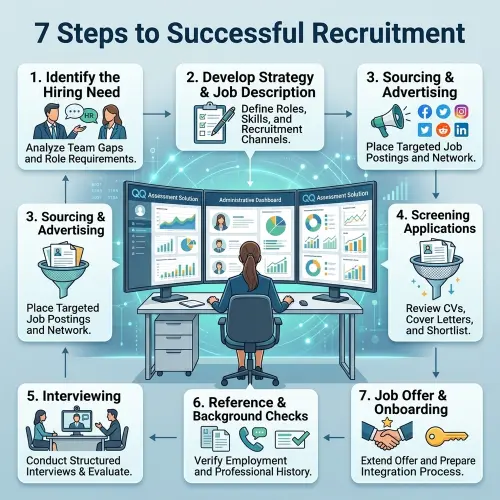
A successful recruitment process follows a structured path from identifying the hiring need to integrating the new employee. The 7 essential steps are: (1) Identify the Hiring Need, (2) Develop a Strategy and Job Description, (3) Sourcing and Advertising, (4) Screening Applications, (5) Interviewing, (6) Reference and Background Checks, and (7) Job Offer and Onboarding. Platforms like QQ Assessment help organizations accelerate this journey with AI-powered skill assessments, automated analytics, and secure proctoring — ensuring the right candidate is selected the first time while reducing time-to-hire and recruitment costs.
Why a Structured Recruitment Process Matters in 2026
Hiring the right person has never been more critical — or more expensive. According to the SHRM 2025 Recruiting Benchmarking Report, the average U.S. hire now takes 44 days and costs $4,700, up from 33 days and $4,425 just four years earlier. High-performing talent acquisition teams focus on filtering out the wrong people as early as possible. Speed is a byproduct of better filters. If your time-to-hire exceeds 30–40 days, you risk losing top candidates to faster-moving competitors.
Up to 60% of candidates abandon job applications mid-process due to complexity or length. That's a process problem, not a professionalism one. A structured recruitment framework removes the conditions that make ghosting rational — on both sides.
The 7 Essential Steps to Successful Recruitment
Step 1: Identify the Hiring Need
Every effective recruitment process begins before a role is advertised. Workforce planning, job description creation, and hiring manager alignment must happen first.
What to do:
• Determine what gaps exist in your workforce
• Analyze the job tasks and responsibilities
• Review or update the position description
• Confirm the role is approved by finance
How QQ Assessment helps: Our platform provides competency analysis tools to precisely identify skill gaps. By mapping required competencies against your current workforce data, you can define the role with data-driven accuracy.
🔗 Related reading: Essential Things You Need in Your Assessment Software
Step 2: Develop a Strategy and Job Description
Write a clear, compelling job description outlining core responsibilities, required skills, and salary expectations. Use real-time salary data to ensure your offer is competitive.
What to do:
• Craft a job description that reflects both technical requirements and cultural fit
• Benchmark salary against market data
• Define pass/fail criteria for each stage before you start screening
How QQ Assessment helps: Link your job description directly to measurable competency benchmarks. Our platform allows you to create custom assessment blueprints that align with your job requirements from day one.
🔗 Related reading: What is Psychometric Analysis?
Step 3: Sourcing and Advertising
Post the opening on job boards like Indeed and LinkedIn, leverage employee referral programs, and use social media and industry networks.
Key insight: 70% of the global workforce consists of passive candidates who are not actively job hunting. Yet 87% of both active and passive candidates say they are open to new opportunities if the right one comes along. The question is no longer how to attract applicants — it's how to reach qualified candidates before competitors do.
What to do:
• Build proactive talent pipelines before hiring demand becomes urgent
• Use multiple recruitment channels to widen your reach
• Leverage employee referral programs
How QQ Assessment helps: Our platform integrates with your existing Applicant Tracking System (ATS) to streamline candidate sourcing and accelerate the screening process.
Step 4: Screening Applications
Review resumes and narrow the candidate pool through quick phone screens or skills-based assessments.
The problem: Most bottlenecks don't live in sourcing — slow resume review and long interview loops typically cost more days. According to CareerPlug 2025, only 1 in 180 applicants ultimately gets hired.
What to do:
• Deploy automated skill assessments early in the process
• Use structured screening criteria to eliminate bias
• Move qualified candidates to the next stage quickly
How QQ Assessment transforms this step: Our AI-powered assessment engine automates preliminary skill evaluations, instantly scoring candidates on technical and cognitive abilities. This reduces manual screening time by up to 70% while improving hiring quality.
🔗 Related reading: Assessment Analytics: How to Transform Assessment Data into Strategic Decisions
Step 5: Interviewing
Conduct structured, behavioral-based interviews with a consistent set of questions to evaluate both technical skills and cultural fit.
Best practice: Structured interviews — where every candidate is asked the same questions in the same order — are proven to be far more predictive of job performance than unstructured conversations.
What to do:
• Prepare a standard interview guide for all candidates
• Include behavioral questions ("Tell me about a time when...")
• Use a consistent scoring rubric
How QQ Assessment helps: Before the interview, you can share pre-interview assessment reports with hiring managers, giving them objective data on each candidate's skills and competencies. This allows interviews to focus on deeper discussions rather than basic skill verification.
🔗 Related reading: How AI is Transforming Educational Assessment in the Middle East
Step 6: Reference and Background Checks
Verify the candidate's employment history, qualifications, licenses, and professional references.
What to do:
• Contact provided references directly
• Verify employment dates and job titles
• Check professional licenses and certifications where applicable
How QQ Assessment helps: Our platform's identity verification and secure proctoring features ensure that all assessment data is authentic and tamper-proof. When you hire based on verified competencies, you can trust the results.
Step 7: Job Offer and Onboarding
Extend an official, written employment offer detailing compensation, hours, and start date. Then welcome the new hire with necessary equipment, introductions, and orientation to ensure a smooth transition.
What to do:
• Prepare a formal offer letter
• Set clear expectations for the first 30-60-90 days
• Assign a mentor or buddy for the new hire
How QQ Assessment helps: Post-hire, our platform supports continuous assessment and development tracking, allowing you to measure new employee progress against onboarding goals.
🔗 CTA: Ready to transform your recruitment process? Request a Demo of QQ Assessment and see how our platform can reduce your time-to-hire by up to 40%.
Frequently Asked Questions About Successful Recruitment
What are the 7 steps of a successful recruitment process?
The 7 steps are: (1) Identify the Hiring Need, (2) Develop a Strategy and Job Description, (3) Sourcing and Advertising, (4) Screening Applications, (5) Interviewing, (6) Reference and Background Checks, and (7) Job Offer and Onboarding.
How can QQ Assessment improve my recruitment process?
QQ Assessment provides AI-powered skill assessments, automated scoring, and detailed analytics that reduce screening time by up to 70%, eliminate bias, and ensure you hire the most qualified candidates the first time.
What is the most critical step in the recruitment process?
While all steps are important, Step 4 (Screening Applications) is often the most critical. This is where poor filtering leads to unqualified candidates reaching interviews — wasting time and resources. Automated skill assessments dramatically improve efficiency at this stage.
How long should a recruitment process take?
The average U.S. hire takes 44 days. Aim for under 40 days to avoid losing top candidates to competitors. With automated assessments, you can compress the screening phase significantly.
Conclusion: Building a Recruitment Process That Works
A successful recruitment process is not about finding the perfect candidate — it's about building a system that filters out the wrong ones as early as possible. By implementing these 7 structured steps and leveraging intelligent assessment technology like QQ Assessment, your organization can:
Reduce time-to-hire by up to 40%
Eliminate bias in screening
Improve quality-of-hire through objective competency data
Create a seamless candidate experience
Ready to optimize your hiring process? Contact us today to learn how QQ Assessment can help you build a world-class recruitment workflow.
Request a Demo — See QQ System in Action.