


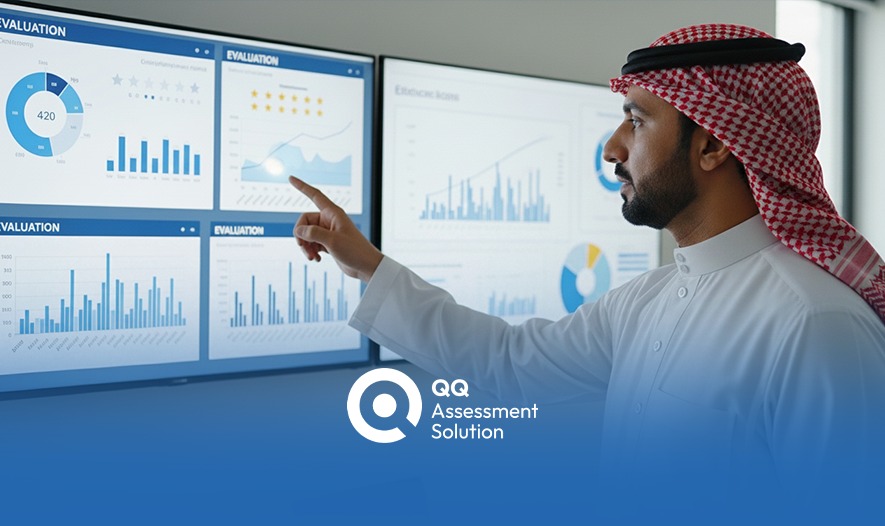
Assessment Analytics: How to transform assessment data into strategic decisions?
In the past, the assessment stage represented the final step in the educational process, ending once students’ grades were recorded and certificates were issued. Its primary purpose was limited to determining whether a student passed or failed, as the results were presented as raw numbers without being used in a deeper or more meaningful way to improve the learning outcome. This created a clear gap and disconnect between what assessment actually measured and the educational objectives it was meant to support and evaluate.
Today, with the advancement of technology in the education sector and the emergence of AI-powered assessments, it is no longer sufficient to simply know whether students pass or fail. It has become essential to go deeper into data analysis to uncover strengths and weaknesses, not only among students but across all aspects of the educational process. The goal is to make informed decisions that contribute to the comprehensive and effective development of education.
With the spread of various assessment tools and systems, the assessment stage has transformed from being the end of the educational process into a fundamental starting point through which well-informed educational insights and strategies are built. These strategies contribute to the development of curricula and teaching methods in line with current advancements.
From here, we move to an important concept that has become central to this transformation: assessment analytics, which serves as the bridge between data generation and informed educational decision-making.
The concept of assessment analytics
It’s considered one of the most important educational processes that universities and educational institutions rely on today. It aims to measure students’ academic performance by tracking their grades, then analyzing this data to derive precise indicators that help determine the extent to which educational objectives are being achieved.
This stage relies on modern and advanced tools and technologies to collect, analyze, and present data in the form of a comprehensive set of reports and detailed analytics.
Through these reports, educational institutions can identify students’ strengths and weaknesses, as well as understand general trends in academic performance. It contributes to improving the quality of education, developing curricula, and supporting informed educational decisions, thereby enhancing the effectiveness of academic assessments and the overall efficiency of the educational process.
The role of assessment analytics in improving the quality of education
It plays a key role in improving the quality of the educational process, as it helps achieve a set of fundamental objectives that are reflected in the quality of education and the efficiency of its outcomes. It goes beyond simply measuring students’ grades to include deeper analysis that contributes to developing various aspects of the educational system. This can be illustrated through the following points:
- Identifying strengths and weaknesses
Analytics helps identify areas where students excel and areas that need improvement, enabling the design of targeted support programs to effectively enhance their core skills. It also helps measure the extent to which learning outcomes are achieved in each course.
- Improving teaching methods
By analyzing student results, faculty members can evaluate the effectiveness of their teaching methods and adjust them to better suit students’ actual needs, which contributes to improved performance and a more efficient educational process.
- Enhancing curriculum quality
Analytics allows for continuous review of curricula to ensure they align with students’ levels and abilities, as well as identifying errors or biases in assessment design and correcting them. This ensures the development of more relevant and up-to-date educational content.
- Accurately evaluating teachers’ performance
Assessment results serve as an important indicator of a teacher’s ability to deliver information effectively. They also provide accurate data that helps educational institutions design targeted training programs to improve academic performance.
- Making informed educational decisions
Analytics is used as a key tool for making data-driven decisions, whether in modifying curricula, allocating educational resources, or improving assessments. This supports building a more accurate and transparent evaluation system.
- Enhancing the efficiency of assessment tools
Data analysis contributes to improving fairness and objectivity in evaluating student performance, and enhances assessment tools through precise and transparent mechanisms that ensure high-quality measurement within educational institutions.
- Monitoring and improving overall performance
Analytics enables educational administrators to track overall student achievement levels and compare them across different semesters, strengthening their ability to plan and make effective strategic decisions.
- Promoting a culture of continuous improvement
It helps establish a culture of continuous improvement within the educational environment by transforming results into actionable development plans that enhance the quality of education in a sustainable way.
The Reports Assessment Leaders Need in universities
Assessment managers in universities need a comprehensive set of reports that go beyond simply displaying grades and instead provide an in-depth analytical view.
These reports include:
- General results reports: which provide a quick overview of average scores, as well as pass and fail rates.
- Student performance reports: which present each student’s level and highlight their strengths and weaknesses.
- Question analysis reports: which help identify easy and difficult questions and evaluate their quality.
- Comparison reports: which allow performance comparisons between students, classes, or different programs.
- Performance development reports: which illustrate how students’ performance improves over time.
- Forecasting reports: which help predict students who may face difficulties in the future.
These reports make the assessment process more transparent and enable decision-makers to move from simply tracking results to gaining a true understanding of performance and making data-driven decisions.
Challenges in Assessment Analytics and How to Overcome Them
Despite the great importance of data analytics and AI-powered assessments in improving the quality of education and enabling accurate decision-making, this process is not without several challenges that may affect the accuracy of its results. The most notable of these challenges include:
- Reliance on manual analysis, which increases the likelihood of human error and affects the accuracy and integrity of results.
- Delays in generating reports, especially in educational institutions that depend on traditional assessment methods.
- Limited coverage of reports, as some reports do not include important interactive and behavioral aspects of student performance.
- Difficulty in linking learning outcomes to student results, due to the lack of advanced analytical tools that support this connection.
- Data security challenges, and the need to maintain the confidentiality of student information.
- Bias in data interpretation, which may occur in the absence of clear analytical standards or when relying on inaccurate tools.
To overcome these challenges, smart assessment management systems such as QQ provide integrated solutions that ensure higher accuracy, real-time reporting, and comprehensive insights, supporting more efficient and reliable decision-making.
Why is the QQ system considered the ideal solution in universities?
In light of the challenges facing assessment analytics and the growing need for accurate and comprehensive reporting, the QQ system offers an integrated solution that efficiently meets the needs of universities and educational institutions. It goes beyond simply managing assessments, bringing together AI-powered assessments, intelligent proctoring, and advanced analytics within a single system—ensuring data accuracy and fast access to reports without complexity or delays.
QQ helps assessment managers overcome the limitations of manual analysis through fully integrated grading and result extraction modules. It also provides interactive dashboards and clear reports that cover all aspects of performance, from individual student levels to question quality. Powered by artificial intelligence, the system delivers deeper insights and future predictions that support accurate and effective educational decision-making.
Additionally, the system ensures the highest levels of data security and privacy, while offering a user-friendly experience for both students and faculty members. This makes it an ideal choice for universities and educational institutions seeking to enhance their assessment management system and rely on data-driven decisions.
If you are looking to develop your institution's assessment management system and maximize the value of your assessment data, contact us now to get a free demo of the QQ system and discover how data analytics can improve the quality of education in your institution.