

With the rapid expansion of technology in the education sector, remote exams have become one of the core solutions adopted by many educational institutions. This type of examination offers significant flexibility for students, supervisors, and exam administrators, as exams can be created, managed, and conducted from anywhere across multiple devices.
The primary focus was initially centered on ease of use for all parties. However, as online examination systems evolved, academic cheating methods also became more sophisticated, increasingly relying on advanced tools and technologies that are difficult to detect through traditional methods.
As these challenges continue to grow, the need for online assessment program that combine ease of use with high levels of security and reliability has become more important than ever. Such solutions help ensure academic integrity while maintaining the quality of educational outcomes.
Why Traditional Monitoring Is No Longer Enough for Online Assessment Systems
With the continuous emergence of new cheating techniques and methods, traditional proctoring approaches have become less effective, especially in remote examination environments. Relying entirely on conventional monitoring also requires significant time and operational effort.
At the same time, educational institutions are increasingly focused on achieving the right balance between user convenience and exam security, ensuring academic integrity without negatively impacting the overall user experience.
For this reason, many educational institutions are increasingly adopting online assessment program that help them to:
- Reduce academic cheating opportunities.
- Simplify exam management and supervision.
- Improve the user experience for students and administrators.
- Generate detailed reports and analytics on student behavior during exams.
- Maintain academic integrity without adding unnecessary complexity.
Common Methods of Cheating in Online Exams
There are various methods students may use to cheat in online exams, ranging from advanced technological tools to more sophisticated versions of traditional cheating techniques. Below are some of the most common cheating methods found in online assessment systems:
1. Easy Access to External Resources
Some students may use the internet or smart devices to access information and answers during exams, which reduces the credibility of the assessment process if effective monitoring tools are not in place.
2. Sharing Answers Between Students
In some online exams, answers can be quickly shared through messaging applications or study groups, especially when questions are identical or presented in the same order to all students.
3. Weak Identity Verification
Without accurate identity verification measures, another person may take the exam on behalf of the student, directly compromising the integrity of the educational process.
4. Lack of Smart Monitoring
Traditional systems may fail to detect suspicious behavior during exams, such as opening other browser tabs, using additional devices, or having multiple people appear in front of the camera.
5. Poor Exam Design
When exam questions are repetitive or displayed in the same sequence for all students, it becomes easier to share answers and exploit weaknesses in the system.
6. Using AI Applications
Artificial intelligence tools such as ChatGPT and Gemini are increasingly being used by some students to generate quick answers during exams. This highlights the importance of intelligent monitoring systems capable of reducing such practices and protecting academic integrity.
How to reduce cheating in remote exams without friction while maintaining a seamless user experience
Many educational institutions make a common mistake when selecting online exam management systems: they assume that adding more complexity is the best way to prevent academic cheating. In reality, however, this often creates a more difficult and frustrating exam experience for students without necessarily improving exam integrity.
Instead of focusing on accessibility and usability, the examination process becomes overloaded with complicated login procedures and lengthy verification steps, negatively affecting student performance and increasing stress during exams.
The real solution is not to complicate the system, but rather to build an intelligent, secure, and seamless testing experience for students, exam creators, and supervisors alike. This can be achieved through several key elements, including:
1. Simplifying the Login Process
Access to exams should be fast and straightforward while maintaining only the essential verification procedures needed to ensure security without sacrificing usability.
2. Using Smart Verification Instead of Complexity
Rather than forcing users through long and exhausting procedures, institutions can rely on intelligent identity verification and behavioral monitoring technologies that are more efficient and flexible.
3. Designing a Comfortable Student Experience
The simpler and clearer the platform interface is, the better students can focus on answering questions instead of struggling with technical difficulties or platform complexity.
4. Leveraging Smart Analytics
Modern systems no longer rely solely on live monitoring. Instead, they use analytics and behavioral data to identify unusual patterns and suspicious activities during exams, helping institutions strengthen academic integrity with greater accuracy and professionalism.
How to reduce cheating in remote exams without friction through AI Proctoring technologies
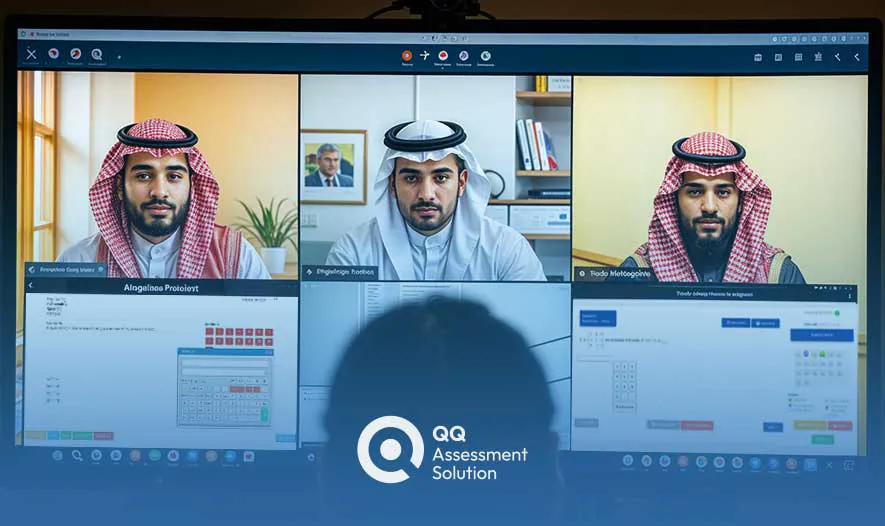
With the growing adoption of remote exams, AI-powered proctoring technologies have become essential for educational institutions not only to reduce the workload on supervisors and invigilators but also to provide greater accuracy and flexibility in monitoring online assessment systems.
These technologies use artificial intelligence to analyze student behavior during exams and detect unusual activities that may occur throughout the testing process, including behaviors that traditional human monitoring may fail to identify.
Examples of activities that intelligent proctoring systems can detect include:
- Switching screens or opening other applications during exams.
- Detecting the presence of multiple individuals in front of the camera.
- Monitoring suspicious movements or behaviors during the exam.
- Sending real-time alerts to supervisors when potential violations occur.
One of the biggest advantages of AI-based monitoring is that it operates intelligently and efficiently without requiring constant human intervention or imposing a stressful and overly complicated experience on students.
It also enables institutions to monitor large numbers of students simultaneously whether hundreds, thousands, or even millions from anywhere, making it a practical and scalable solution for organizations conducting large-scale online examinations.
How to Design More Secure Online Exams
Even when institutions adopt or build an online exam management system that combines usability with security and academic integrity, exam design itself remains a critical factor in reducing cheating opportunities and improving assessment quality.
The more intelligently and strategically exams are designed, the more secure and effective the testing environment becomes without complicating the educational process or negatively affecting the student experience.
Below are some best practices for designing more secure online exams:
1. Use Diverse Question Banks
The greater the variety of questions available within the system, the more difficult it becomes for students to share answers, especially when questions are randomly selected from a large and continuously updated question bank.
2. Randomize Question Order
Displaying questions in a different sequence for each student helps minimize opportunities for unauthorized collaboration and answer sharing during exams.
3. Set Appropriate Time Limits for Each Question
Controlling the amount of time allocated for each question reduces opportunities for external searching or the use of unauthorized tools while maintaining fairness among all students.
4. Prevent Copying and Pasting
Some online exam management systems provide security features that prevent users from copying or transferring exam content easily, helping reduce question leakage and unauthorized distribution.
5. Use Questions That Measure Understanding and Analysis
Analytical and comprehension-based questions reduce the effectiveness of memorization and quick online searches, resulting in more accurate assessments of students’ actual skills and understanding.
How QQ Assessment Balances Security and Ease of Use in Remote Exams
QQ Assessment is one of the modern solutions that helps educational institutions manage online exams more efficiently while maintaining advanced levels of security and academic integrity.
The system provides a wide range of advanced features that support professional online exam management, including:
- AI-powered proctoring technology to analyze student behavior during exams.
- Live monitoring and real-time exam management capabilities.
- Flexible and user-friendly question bank management.
- Detailed reports and analytics to monitor performance and identify unusual behavior.
- A smooth and intuitive interface for both students and supervisors.
- Comprehensive tools for efficient and flexible online exam administration.
As a result, QQ Assessment enables educational institutions to achieve the ideal balance between security and usability, delivering more reliable and professional online examinations without complicating the student experience or disrupting the educational process.
Conclusion
Reducing cheating in remote exams does not necessarily mean adding restrictions or making the user experience more complicated. Successful educational institutions are those that can balance security and usability by adopting online assessment programs and modern technologies that support academic integrity efficiently and flexibly.
As digital education continues to evolve, the demand for professional solutions that streamline exam management while ensuring a fair and seamless experience for all students continues to grow.
If you are looking for a more secure and flexible online examination system, you can contact us to learn how to reduce cheating in remote exams without friction with QQ Assessment. And can it help you create professional online exams that combine academic integrity with a seamless user experience.