

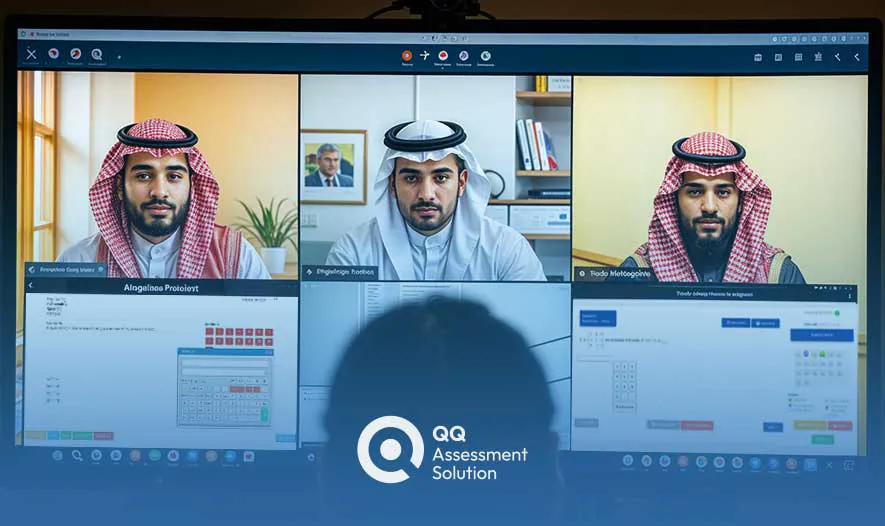
Secure remote exams use identity checks, lockdown software, and live or automated monitoring to prevent cheating. Educational institutions worldwide — from universities to certification bodies — are adopting these layered defenses to protect exam integrity without sacrificing the flexibility of remote assessment.
Why Remote Exam Security Matters More Than Ever
As online exams become the standard for academic institutions, certification bodies, and corporate training programs, the risk of cheating has grown significantly. Students and candidates now use advanced tools such as ChatGPT, Gemini, screen sharing, impersonation, and hidden devices to gain unfair advantages.
Without strong security layers, online exams lose credibility — and institutions risk reputational damage, invalid certifications, and non-compliance with regulatory standards.
5 Essential Security Layers for Secure Remote Exams
Securing remote exams requires a multi-layered approach. No single tool is enough — you need a combination of identity verification, environment monitoring, browser control, intelligent proctoring, and smart assessment design.
1. Identity Verification
Test-takers must show a valid government-issued photo ID and complete a live facial scan or biometric check. This stops impersonation — one of the most common forms of exam fraud — and confirms that the registered candidate is the person actually taking the exam.
2. Environment & Room Scans
Candidates use their webcam or mobile camera to inspect their desk and surrounding room for unauthorized devices, notes, or other people. A 360-degree room scan ensures no blind spots are left unsupervised.
3. Lockdown Browsers
Security software like Safe Exam Browser or QQ's secure browser blocks new tabs, external applications, copy-paste functions, screenshot tools, and screen recording. This creates a controlled exam environment where only the assessment window is accessible.
4. Intelligent Proctoring Methods
Modern remote exam security combines multiple proctoring models:
• Automated AI Proctoring: Artificial intelligence analyzes behavior in real time — flagging suspicious eye movements, secondary voices, multiple faces, or unusual patterns.
• Live Proctoring: Human invigilators watch candidates in real time via webcam and audio feeds, allowing immediate intervention when needed.
• Recorded Proctoring: Video and audio sessions are logged and reviewed later by trained reviewers for post-exam analysis.
5. Assessment Hardening
Smart exam design reduces cheating opportunities before the exam even begins. Best practices include:
• Randomizing questions and answer choices for each candidate.
• Using large question banks with continuous updates.
• Enforcing strict time limits with auto-submission.
• Displaying one question at a time and preventing backtracking.
• Using higher-order thinking questions that require analysis and reasoning.
Why Traditional Proctoring Alone Is No Longer Enough
Traditional proctoring methods — relying only on human proctors or basic lockdown browsers — are no longer sufficient. Today's cheating techniques include AI-generated answers, remote access tools, virtual machines, and organized collaboration across messaging apps.
Institutions need solutions that combine:
• Real-time AI behavior analysis.
• Live human monitoring for high-stakes exams.
• Secure browser technology with full lockdown.
• Detailed reporting and audit trails.
• Compliance with data privacy regulations (GDPR, PDPL).
How QQ Assessment Delivers Secure Remote Exams
QQ Assessment is a comprehensive assessment platform designed to deliver secure, scalable remote exams for educational institutions and enterprises. The platform combines AI-powered proctoring, live monitoring, secure browser technology, and intelligent analytics into a single seamless experience.
Key features include:
• AI-powered proctoring that analyzes candidate behavior in real time.
• Live monitoring capabilities for high-stakes assessments.
• Secure browser with full lockdown mode.
• Identity verification with facial recognition.
• Detailed reports and behavioral analytics.
• Integration with LMS platforms such as Blackboard and Moodle.
• Full compliance with Saudi data privacy regulations.
As a result, educational institutions can achieve the ideal balance between security and usability — delivering reliable, professional online examinations without complicating the student experience.
Frequently Asked Questions About Secure Remote Exams
What is the best way to secure remote exams?
The most effective approach combines 5 layers: identity verification, environment scanning, lockdown browsers, intelligent proctoring (AI + live + recorded), and assessment hardening through randomization and time limits.
Can AI proctoring detect ChatGPT and other AI tools?
Yes. Modern AI proctoring systems detect unusual patterns such as switching screens, opening other applications, typing anomalies, and access to unauthorized resources during exams.
How does QQ Assessment secure remote exams?
QQ Assessment combines AI proctoring, live monitoring, secure browser technology, identity verification, and intelligent analytics into a single seamless platform — protecting exam integrity while maintaining a user-friendly experience for students and administrators.
Do online exams need both AI and live proctoring?
For high-stakes exams, combining AI and live proctoring provides the highest level of security. AI handles behavior analysis at scale, while live proctors offer human judgment for critical situations. For lower-stakes assessments, AI-only proctoring may be sufficient.
Is remote proctoring compliant with data privacy laws?
Yes, when implemented correctly. Platforms like QQ Assessment comply with GDPR, PDPL (Saudi Arabia), and other data protection regulations. Institutions should always verify compliance before selecting a proctoring solution.
Conclusion
Securing remote exams is no longer optional — it's essential for maintaining academic integrity, protecting institutional reputation, and ensuring that credentials are earned honestly. By implementing a multi-layered approach with identity verification, secure browsers, AI proctoring, live monitoring, and smart assessment design, institutions can deliver exams that are both fair and frictionless.
If you are looking for a secure, scalable remote exam solution, contact us to learn how QQ Assessment can help you deliver professional online exams that combine academic integrity with a seamless user experience.
Request a Demo — See QQ System in Action.